

A surface that already exists.
Why the roof
A luxury Mediterranean villa is, before anything else, an architectural plane held up against the sky. In the Mediterranean, that plane is typically 400 m² of usable roof surface — sometimes more, rarely less for the kind of estate this venture addresses. It is already built. It is already paid for. It already faces the weather.
Across an average Mediterranean year that surface receives on the order of 400 litres of rainfall per square metre. Multiplied across a 400 m² roof, that is roughly 160 000 litres of clean atmospheric water arriving annually onto a structure the owner already paid an architect to design. Materially more water than the household consumes — and, in the current building stock, almost none of it kept. It runs to the eave, sheets off the tiles, and disappears into the soil or the drain.
The starting question of this venture is not how do we build a water plant. It is: why is this surface, which receives the resource for free, treated as if it did not exist?
Why PV-as-catchment works
A photovoltaic module is, by construction, exactly the surface a hydraulic engineer would specify for rainwater capture. It is tilted. It is glass-fronted. It is hydrophobic. It is self-cleaning under rainfall. It is mounted on a frame engineered to shed weather loads at a defined angle.
The orientation question is the elegant part. To maximise annual solar yield at this latitude, the array is set south-facing at roughly 20–35° of pitch. That is also, almost exactly, the geometry a roofer would choose to channel rainfall efficiently to the eave without ponding, without lateral runoff loss, and without the velocity that erodes a gutter. The optimum for the sun and the optimum for the rain are the same optimum.
That convergence is the architectural premise of Las LLuvias: the roof does not have to be redesigned to do both jobs. It already does both. What has been missing is the downstream path that treats the second output as infrastructure rather than runoff.
From rainfall to potable water
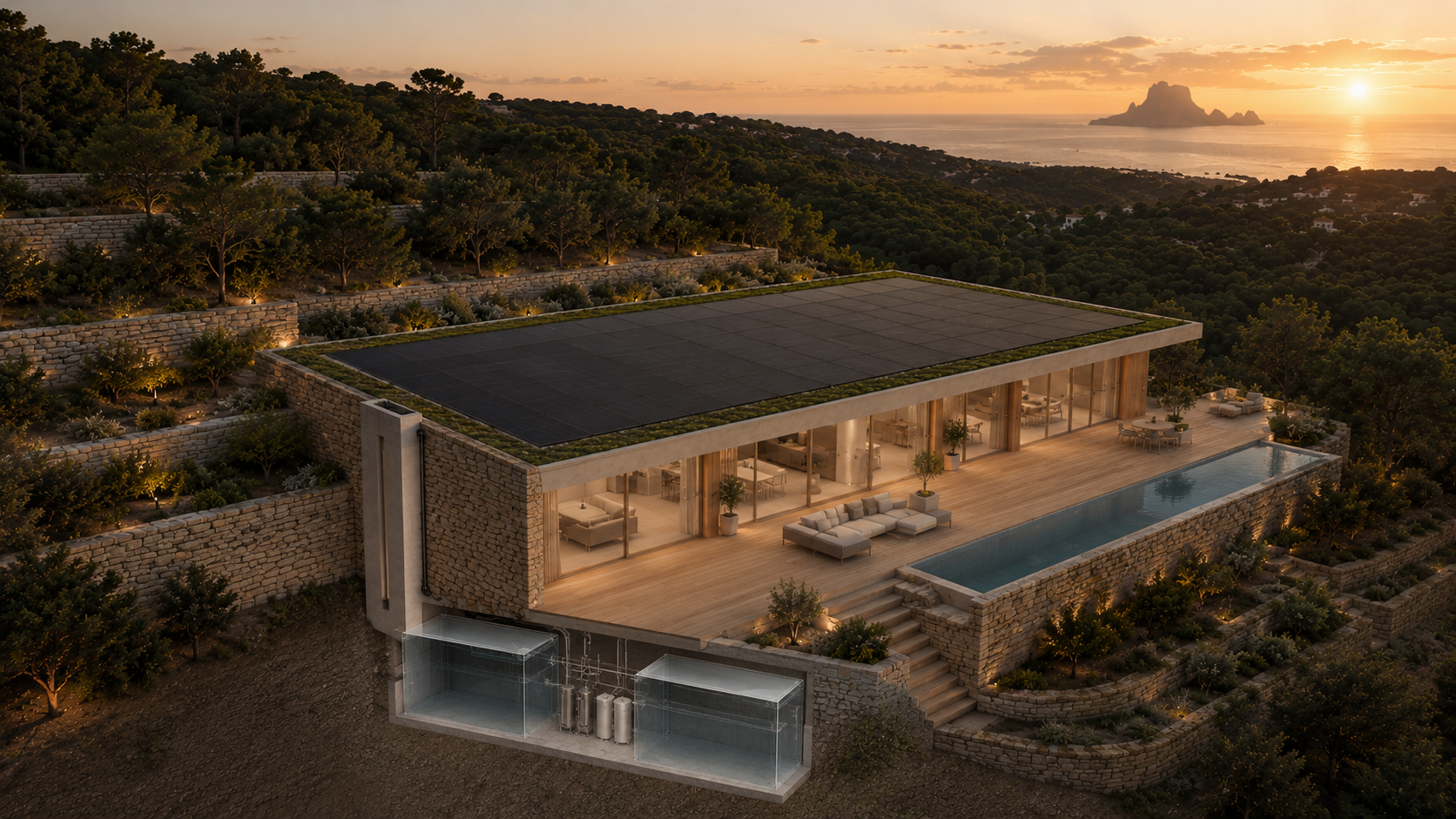
At a high level, the water path is conventional in name and uncompromising in execution: rainfall arrives at the roof surface, is collected at the edge, and is carried into storage. From there it passes through a certified treatment process and is delivered into potable storage for household use.
The engineered detail of that process — the collection geometry and the multi-stage treatment specification — is proprietary and is documented separately under confidentiality. The point of this page is the principle, not the method: the roof the household already owns becomes the source of the water it drinks.
Two approaches, one outcome
Las LLuvias is delivered in two architectural approaches, addressing two different building situations — from full new-build integration to the heritage-sensitive parcel where a traditional finished elevation is required. Both deliver the same outcome from the same roof: solar electricity and certified potable rainwater. The engineering that distinguishes them is proprietary and is not described here.
Both architectures deliver the same downstream water path and the same certification envelope. The choice between them is a function of the building — its existing structure, its aesthetic register, and the owner's preference. The full typology, the trade-offs, and the cost profile are discussed in Architecture.
What it returns
The arithmetic is what makes the surface worth re-positioning. 400 m² of roof, multiplied by a ~400 L/m²/yr of rainfall, yields on the order of 160 000 litres of raw catchment per estate per year. After collection and treatment losses, the deliverable potable volume sits comfortably above household demand.
A household uses approximately 100 litres per person per day. For a typical four-person estate that is around 146 000 litres per year. The architecture covers the household — with the surplus available for landscape irrigation, pool top-up, or storage against the dry months. The roof, in other words, produces more potable water than the people under it consume. It always did. The venture is the path between the two.